
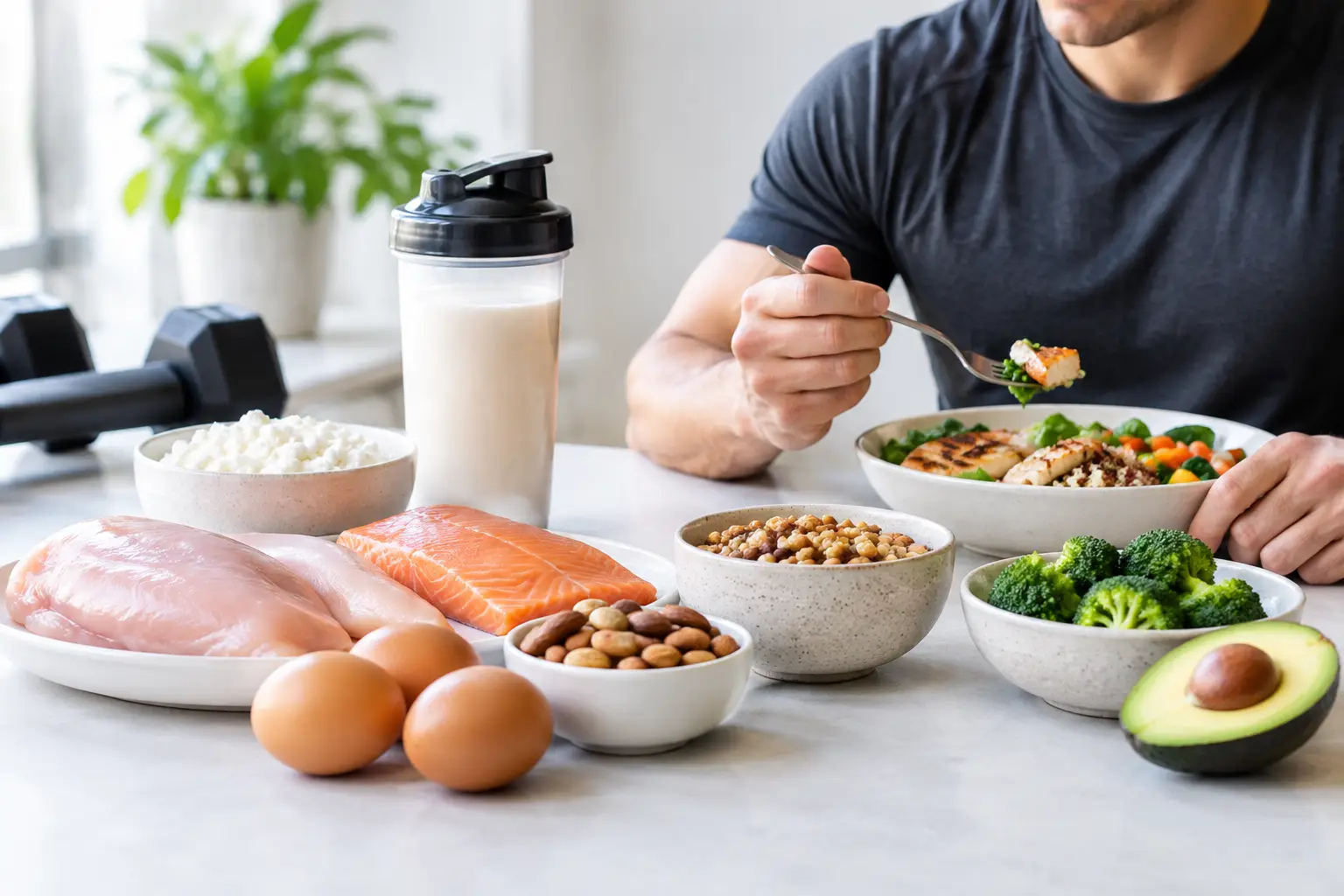
Muscle is not built by one high-protein dinner after a hard session. Protein intake for muscle gain works best when it supports the whole picture: enough total food, regular resistance training, recovery, and a pattern you can repeat on ordinary weekdays as well as weekends.
For many people, the next challenge is not learning that protein matters. It is working out how to spread it through the day, adjust it when body weight changes, and avoid turning every meal into a complicated calculation. A few useful numbers can make those decisions much clearer.
Start with a daily protein target
For adults doing regular resistance training and aiming to build muscle, a practical starting range is around 1.6 to 2.2 grams of protein per kilogram of body weight each day. Someone weighing 70 kg, for example, might aim for roughly 112 to 154 g daily.
The lower end can work well for people who are new to training, eating enough calories and progressing steadily in the gym. The higher end may be more useful during a calorie deficit, for experienced lifters, or when appetite makes it difficult to preserve lean mass. More is not automatically better. Once your intake is consistently within a sensible range, training quality, total energy intake and sleep often matter more than pushing protein ever higher.
If you carry a significant amount of extra body fat, using a goal weight or estimated lean body mass can prevent a target becoming unnecessarily high. The aim is a realistic number that fits your meals, budget and preferences, not a perfect-looking figure that is difficult to sustain.
People with kidney disease, a history of kidney problems, or a prescribed therapeutic diet should get individual advice from a qualified clinician before substantially increasing protein intake.
Protein intake for muscle gain works better when distributed
Your body digests and uses protein from each meal over several hours. You do not need to eat every two hours, but concentrating nearly all of your daily protein into one evening meal can make it harder to get the most from your overall intake.
A useful approach is to divide your target across three to five eating occasions. For many adults, 25 to 40 g of high-quality protein per main meal is a practical ballpark. Larger people may need more, while smaller people may do well with less. What matters is that each meal makes a meaningful contribution rather than providing only a few grams.
Consider a person aiming for 120 g daily. They could have 30 g at breakfast, 30 g at lunch, 35 g at dinner and 25 g in an afternoon snack. That pattern is often easier to manage than trying to make up 80 g after work because breakfast and lunch were low in protein.
Make breakfast do more work
Breakfast is commonly the weakest protein meal, particularly when it consists mainly of toast, cereal or fruit. There is nothing wrong with those foods, but adding a protein source can make the day easier to manage. Eggs, Greek yoghurt, cottage cheese, milk, soy yoghurt, tofu, beans or fish can all contribute, depending on your preferences.
This is not a rule that breakfast must be large. It is simply a chance to avoid starting the day with a major gap that must be recovered later. If you do not eat breakfast, plan where that protein will realistically come from instead.
Treat snacks as useful, not compulsory
A protein-containing snack can help when there is a long stretch between meals, when you train after work, or when your usual meals do not quite reach your target. It is optional, not a requirement. If three meals already provide enough protein and energy, another snack may add little besides calories you do not need.
Match protein to your calorie goal
Protein supports muscle growth, but it cannot fully compensate for too little energy. Building new tissue requires resources. If your primary goal is gaining muscle and strength, a modest calorie surplus is usually more productive than eating at maintenance or repeatedly under-eating.
A small surplus is often enough. Rapid weight gain does not mean rapid muscle gain, and it can make it harder to tell whether your plan is working. Track body weight under similar conditions several times a week, then look at the average trend over two to four weeks. Strength improvements, training performance, waist measurements and how clothes fit provide useful context alongside the scale.
If fat loss is your current priority, muscle gain can still be possible, especially for beginners, people returning to training, and those with more body fat to lose. The process is slower and more dependent on consistent lifting. In this situation, keeping protein towards the upper end of your practical range may help protect lean mass while calories are lower.
Carbohydrates and fats still have jobs to do. Carbohydrates can support training performance, while fats help make meals satisfying and support normal body functions. Building a plate entirely around protein may leave little room for the foods that help you train well and enjoy eating.
Use training to give protein a purpose
Resistance training is the signal that tells your body there is a reason to maintain or build muscle. Protein provides the raw material, but without a progressively challenging training plan, extra protein has limited value for muscle gain.
You do not need a perfect post-workout meal within a narrow window. Having protein sometime in the few hours before or after training is generally practical, especially if it helps you meet your daily total. The bigger priority is avoiding a pattern where hard sessions are followed by long periods with no food and consistently low overall intake.
Progressive overload matters too. Over time, aim to add repetitions, weight, sets, improved control or range of movement where appropriate. If your protein target is consistent but your exercises, loads and effort never change, your results are likely to plateau.
Choose foods you can repeat
The best protein sources are the ones you will eat consistently. Animal foods such as dairy, eggs, poultry, lean meat and fish can make targets straightforward. Plant foods including tofu, tempeh, soy products, lentils, beans, peas, wholegrains, nuts and seeds also contribute meaningfully.
People eating mostly plant-based diets may benefit from a little more planning because protein is often spread across a larger volume of food. Combining varied plant sources across the day helps cover a broad range of amino acids. A meal of lentils with grains, tofu with rice, or beans on wholegrain toast can be both practical and effective.
Food choice also depends on total calories. Full-fat dairy, nuts and fattier cuts of meat can be useful when you need more energy for muscle gain. Leaner options may make target-setting easier during fat loss. Neither approach is universally better; it depends on your calorie needs and what keeps you satisfied.
Review the plan before changing it
Give a new protein routine at least two weeks of reasonably consistent effort before judging it. Then ask practical questions. Are you reaching your target on most days? Is your body weight moving in the intended direction? Are your lifts, repetitions or workout quality improving? Do you feel overly hungry, overly full or tired during training?
Adjust one variable at a time. If you are struggling to reach protein, improve one low-protein meal rather than redesigning your entire diet. If weight is not rising despite a muscle-gain goal, add a modest amount of food while keeping protein steady. If you are gaining faster than intended, reduce calories slightly rather than cutting protein first.
Consistency will always beat occasional perfect days. Use your protein target as a daily guide, build meals that fit your routine, and let your training progress show whether the plan is helping you move forward with confidence.